Selected work
Selected work: measurement, representation, and computation
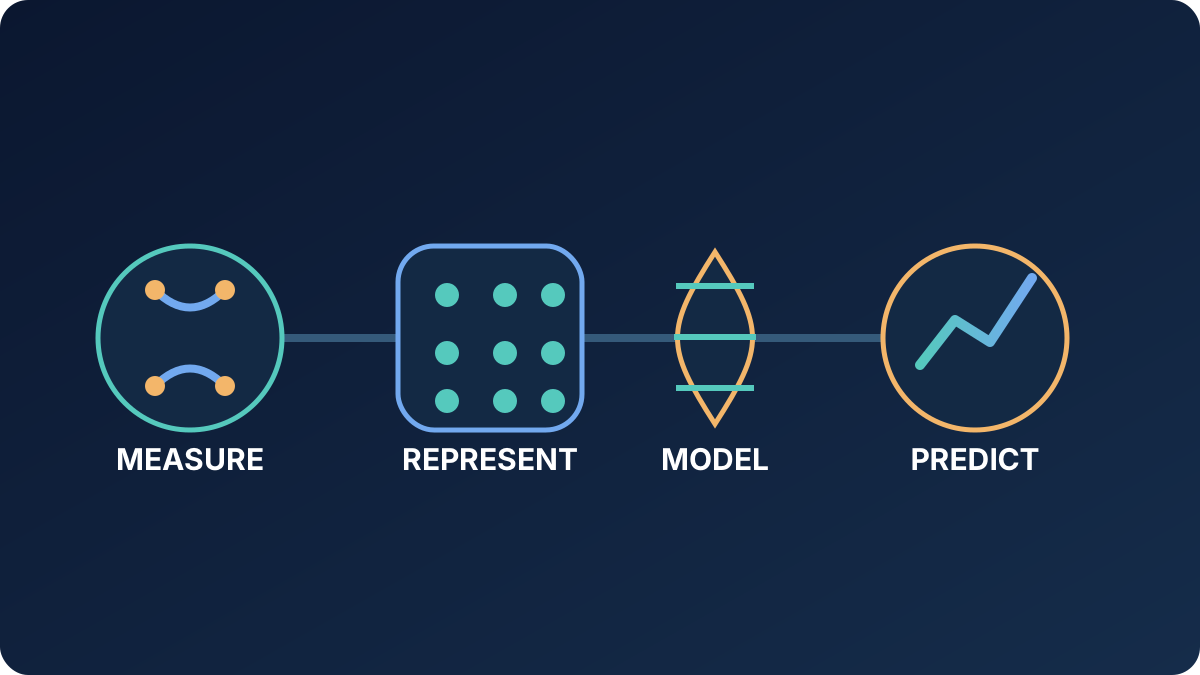
These projects illustrate the common pattern across my work: begin with a foundational obstacle, identify the physical or informational structure that controls it, and build a method that makes reliable inference possible.
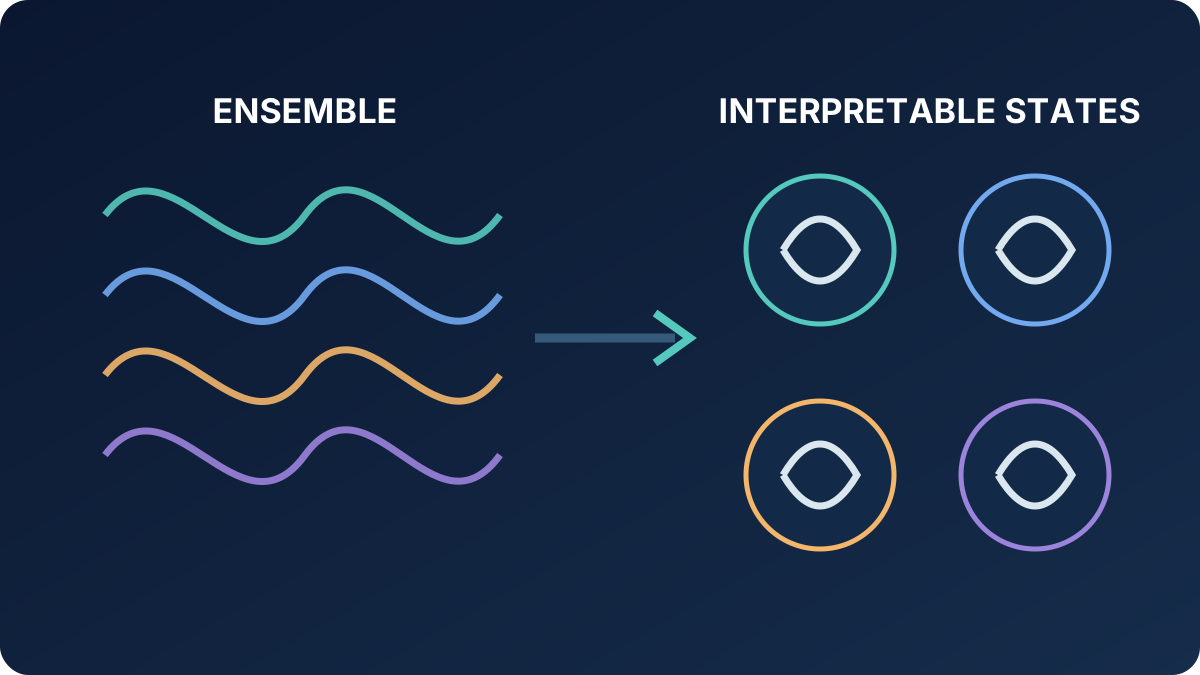
Clustering DNA and RNA ensembles through secondary structure
Problem. Flexible and partially disordered nucleic acids can appear geometrically dissimilar even when they share the same biologically meaningful base-pairing state, making atomistic ensembles difficult to compare and compress.
Approach. We introduced a proper distance based on the number of base pairs that must reorganize between structures. The resulting representation supports k-means, hierarchical, and density-based clustering while ignoring irrelevant internal reorientation.
Why it matters. The method compresses complex molecular-dynamics ensembles into interpretable states and provides structured inputs for downstream statistical or machine-learning models. Code, example datasets, and scripts are publicly available.
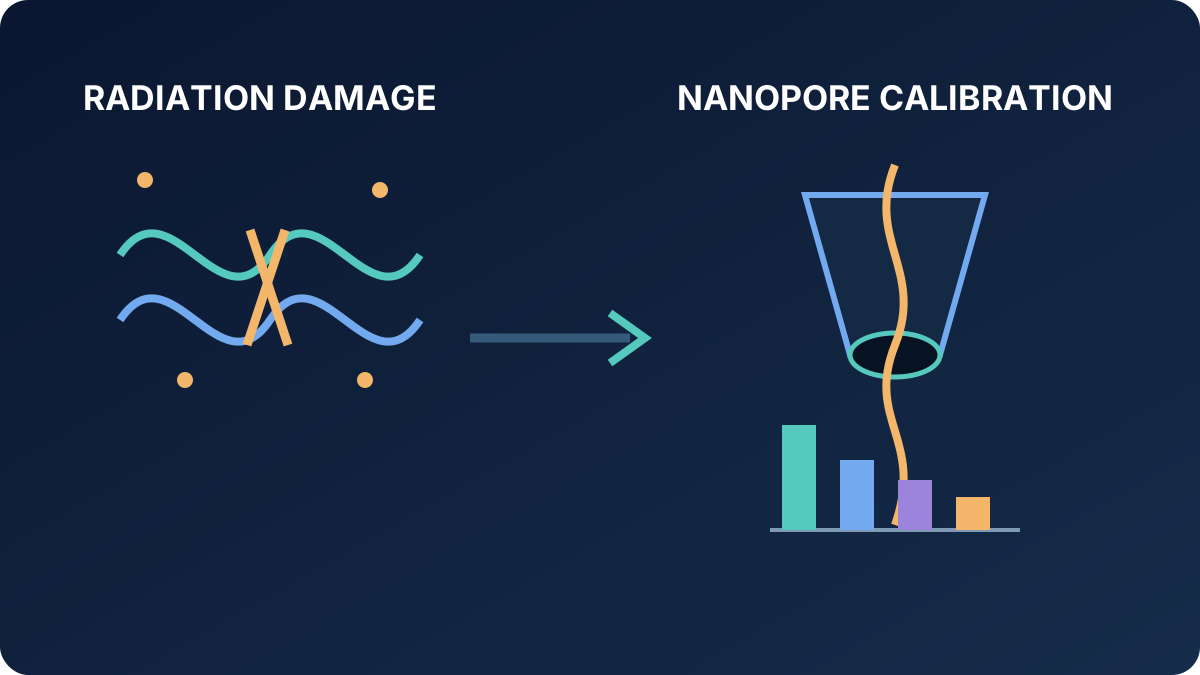
Single-molecule biodosimetry with internal molecular standards
Problem. Nanopores vary in geometry and surface chemistry, so raw event signatures from different devices are not directly comparable. Radiation-dose inference also requires a defensible connection between molecular damage and the measured distribution.
Approach. The measurement uses two DNA standards to calibrate molecular length and concentration within each experiment. A mechanistic model connects single-strand lesions, double-strand breaks, radical chemistry, and the observed dose response.
Why it matters. The work demonstrates how calibration, uncertainty, and physical modeling can turn variable single-molecule data into a quantitative response suitable for comparison across devices and future laboratories.
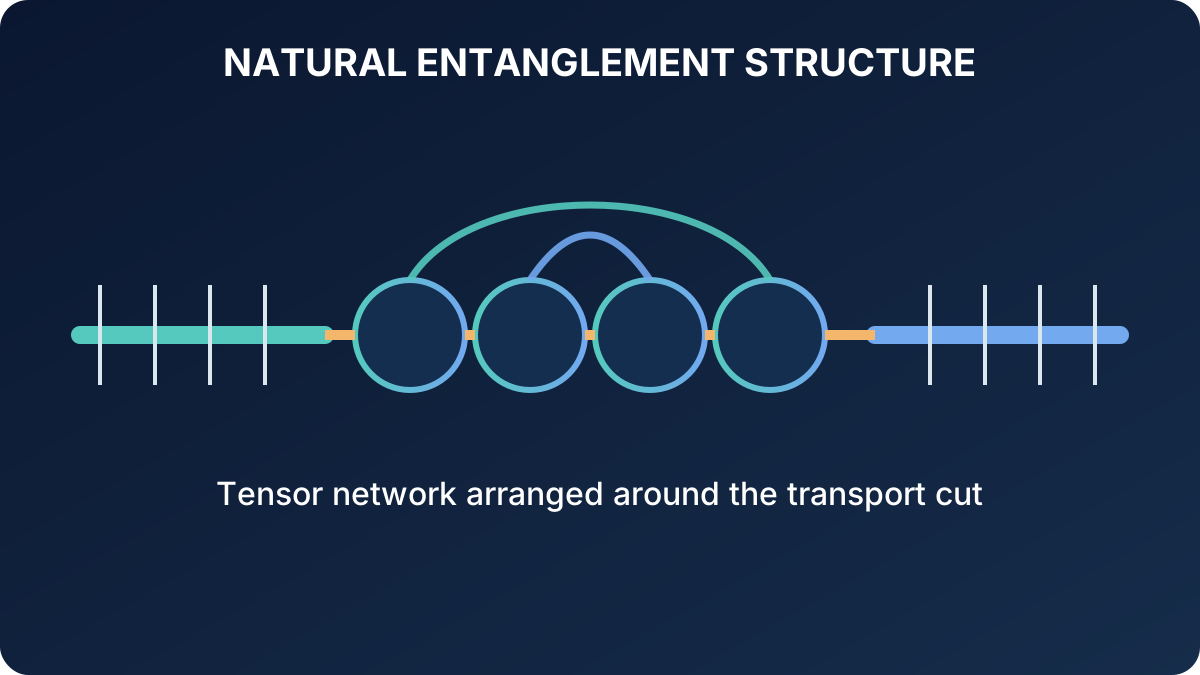
Tensor networks that exploit the natural entanglement of transport
Problem. Standard real-space representations generate entanglement that appears to make long-time nonequilibrium quantum-transport simulations exponentially expensive.
Approach. We identified a mixed system-reservoir basis and tensor-network geometry aligned with the way information is created and carried through the junction. This representation broke the practical entanglement barrier for interacting transport simulations.
New insight. Current work identifies the Fermi-edge structure that controls logarithmic entanglement growth, explains why the approach remains efficient, and demonstrates the scaling rigorously for quadratic systems. Entanglement at the Fermi Edge and Tensor Networks for Transport is under review at Physical Review Letters.
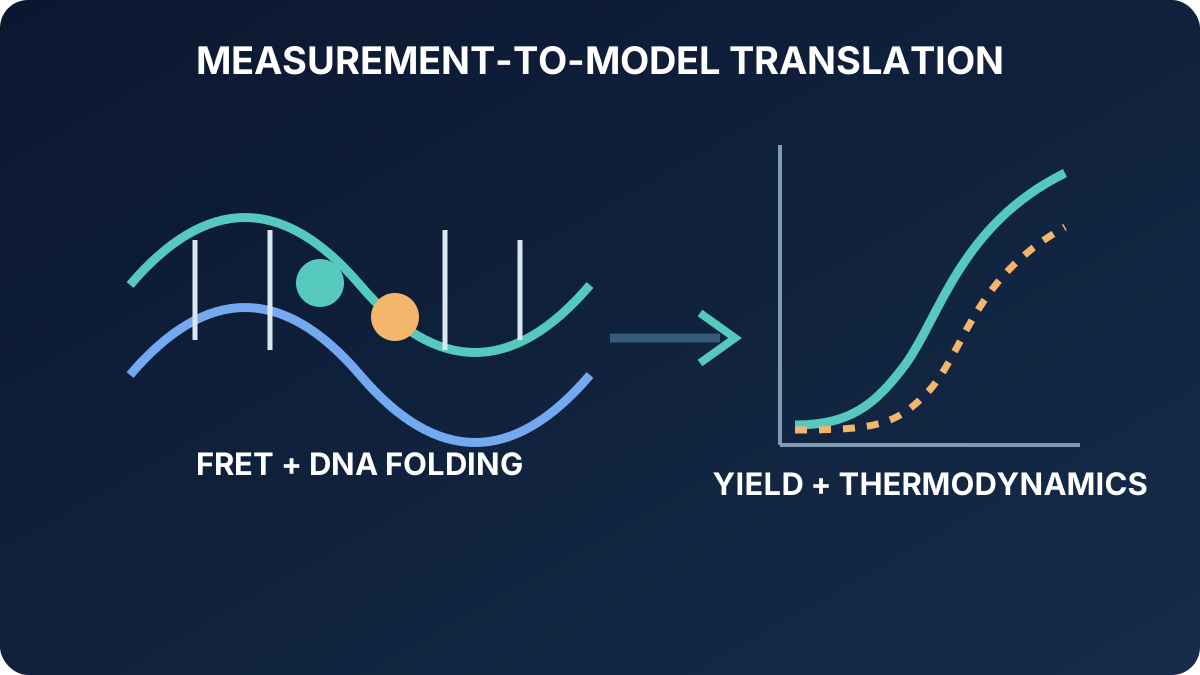
Quantitative DNA folding from fluorescence and thermodynamic models
Problem. Melt curves and FRET signals are often interpreted with idealized assumptions that can confound folding yield, transition thermodynamics, and heterogeneous failure mechanisms.
Approach. We developed affine transformations and critical reassessments of van’t Hoff analysis, linking measured fluorescence to folding yield and thermodynamic quantities while identifying design-dependent barriers to successful self-assembly.
Why it matters. This is a mature example of extracting physical quantities from experimental signals by treating calibration, model assumptions, and uncertainty as part of the inference—not as afterthoughts.
Ion transport and nanochannel optimization
Problem. Finite simulation cells can obscure access resistance, dehydration barriers, and the relationship between pore structure, selectivity, and conductance.
Approach. I developed the golden-aspect-ratio scaling construction for access resistance in molecular dynamics and used atomistic simulations to identify how graphene crown ethers balance electrostatics, hydration, and picometer-scale geometry.
Why it matters. The work shows how finite-size analysis and physically motivated reduced models can reveal design principles that are otherwise hidden in large simulation datasets.
Hidden pathways in biomolecular energy transport
Problem. Ultrafast spectroscopic measurements contain overlapping dynamical processes, while local temperature-like observables do not directly reveal the energy landscape or routes of transport.
Approach. We developed a time-series framework that uses topology and transient response to identify pathways and hidden landscape structure.
Why it matters. The result is a general example of extracting mechanistic information from complex dynamical data rather than treating the observed signal as a single phenomenological decay.