Research
From measurement to representation and prediction
My research connects biological measurement, mechanistic modeling, and scientific computing. The program is organized around three pillars that share a common objective: make complex systems quantitatively understandable without discarding the structure that gives them meaning.
Working method
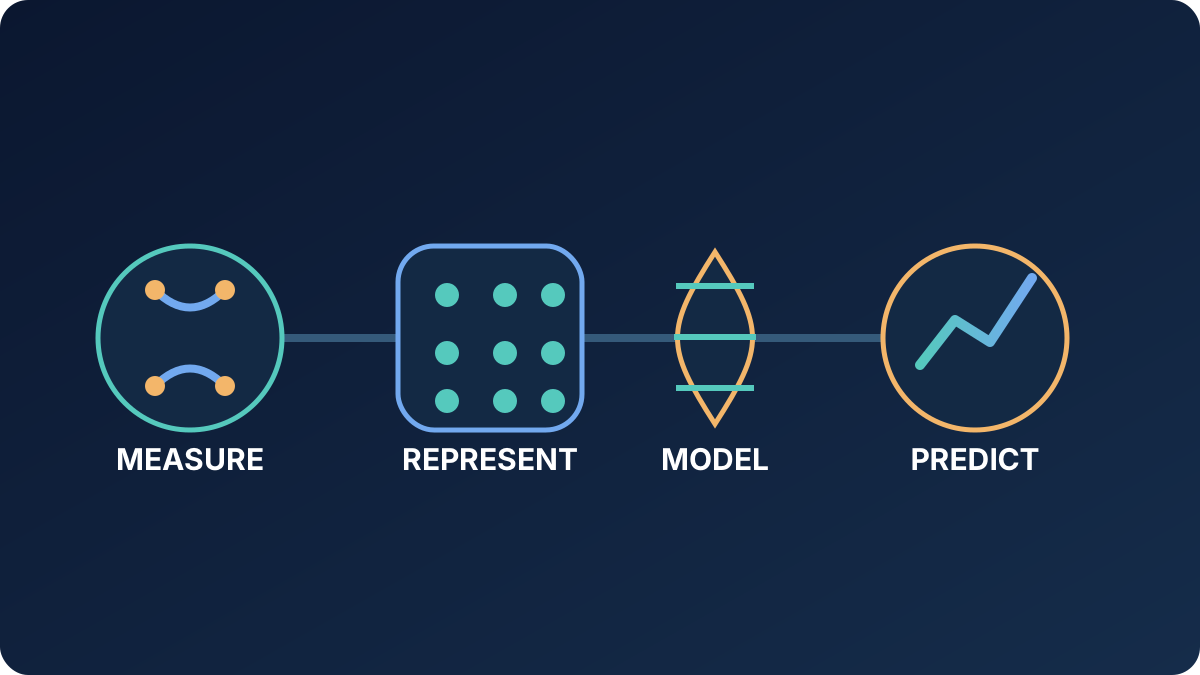
A chain of trust from observation to inference
Reliable inference requires more than a large dataset. It requires knowing what was measured, how the measurement changed the apparent distribution, which variations are biological rather than instrumental, and which representation preserves the relevant physics.
Measure
Define the quantity, calibrate the system, and expose sources of random error and bias.
Represent
Compress the data into variables that retain mechanistic and predictive information.
Model
Build physical and statistical descriptions that connect observations to hidden processes.
Predict
Propagate uncertainty and test whether conclusions transfer across experiments and conditions.
Pillar 1
Biological Measurement & Data Quality
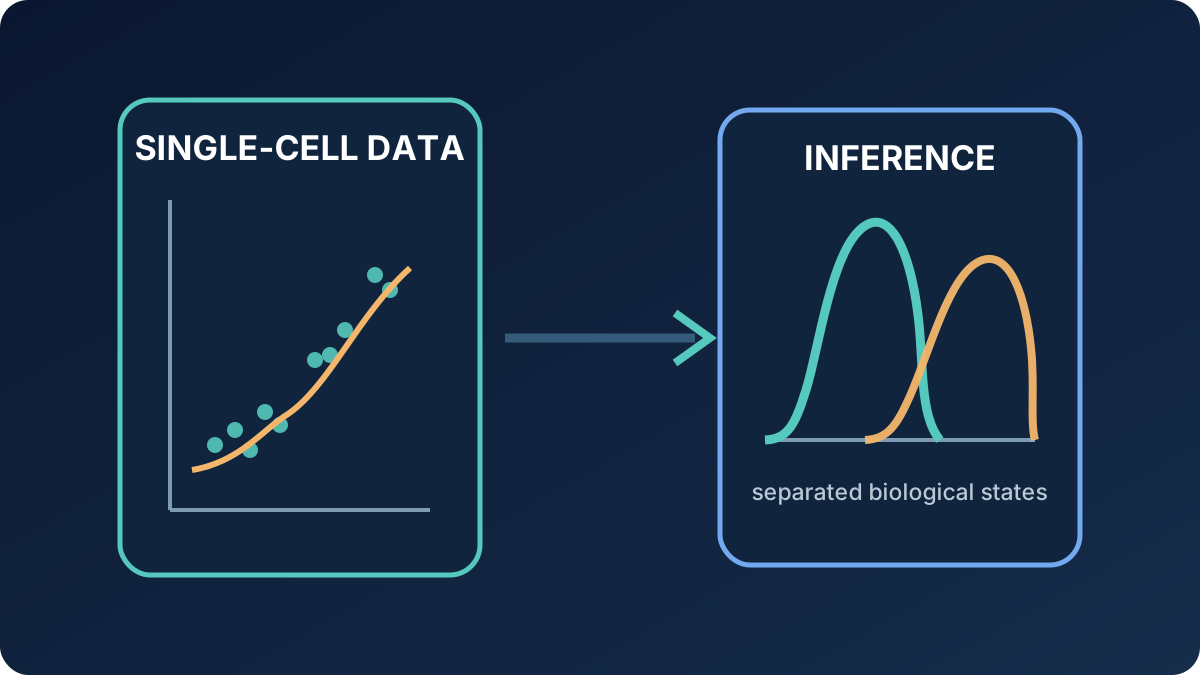
I work closely with experimental scientists from study design and data generation through quality assessment, quantitative analysis, model construction, and biological interpretation. The goal is not only more data, but data whose limitations and meaning are sufficiently understood to support reliable inference.
- Quantitative cytometry: measurement comparability, time-dependent single-cell behavior, and the sensitivity of inferred cell-state distributions to data quality and analytical choices.
- Single-molecule and nanopore measurement: internal standards, calibration across variable devices, event-level analysis, and mechanistic response models.
- Fluorescence/FRET and spectroscopy: translating instrument signals into thermodynamic, structural, and dynamical information.
- Measurement assurance: identifying bias, reducing random error, defining reference quantities, and propagating remaining uncertainty to biological conclusions.
Current direction: This pillar is being extended explicitly toward AI-ready biological data—datasets designed and documented so that models learn transferable biology rather than laboratory-specific artifacts.
Pillar 2
Biomolecular Representations & Simulation
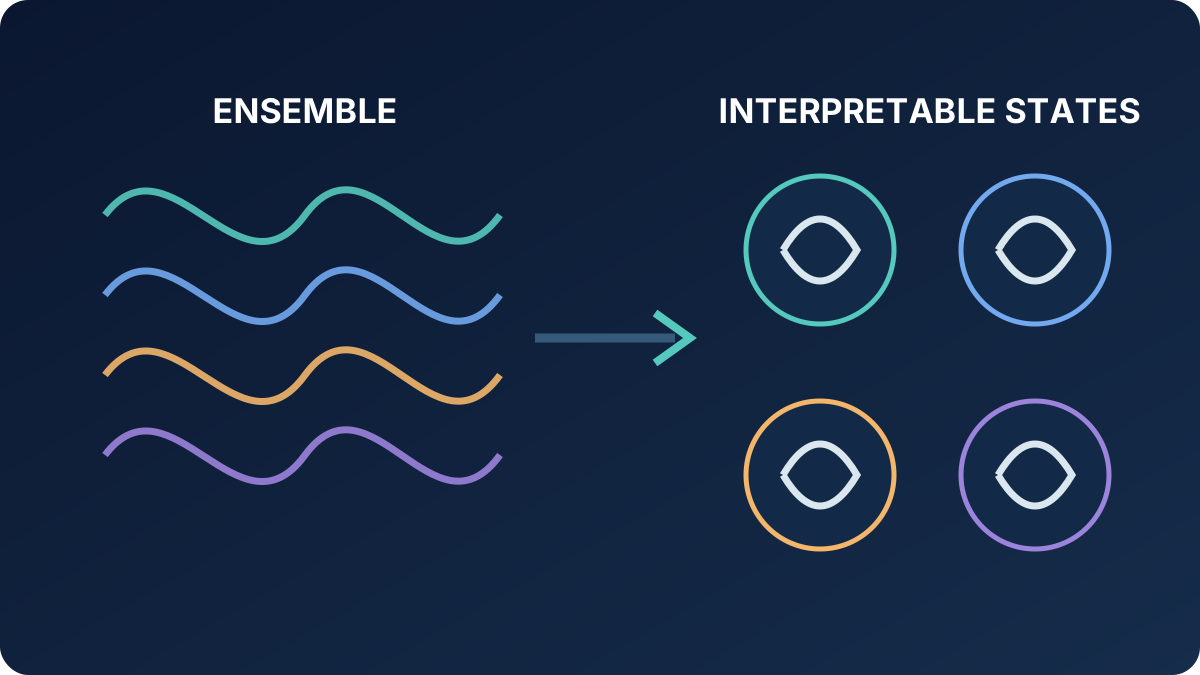
Atomistic trajectories and experimental datasets can be enormous while remaining difficult to compare or interpret. I develop compact representations that reflect molecular structure, energetics, and function rather than merely geometric proximity.
- Nucleic-acid ensembles: secondary-structure distances that permit clustering of flexible DNA and RNA configurations and compress entropic disorder into interpretable states.
- Experiment-simulation interfaces: representations designed to connect measured observables with molecular ensembles and effective physical models.
- Model inference: approaches that can support estimation of effective Hamiltonians, force fields, or reduced dynamical descriptions from experiment and simulation.
- Prediction with interpretation: structured inputs and reduced descriptions that can complement statistical and machine-learning models while preserving physical meaning.
Established foundation and current extension: The secondary-structure clustering framework is published with public code and example data; broader uses for simulation efficiency, model inference, and prediction are active research directions.
Pillar 3
Algorithms for Many-Body Physical Systems
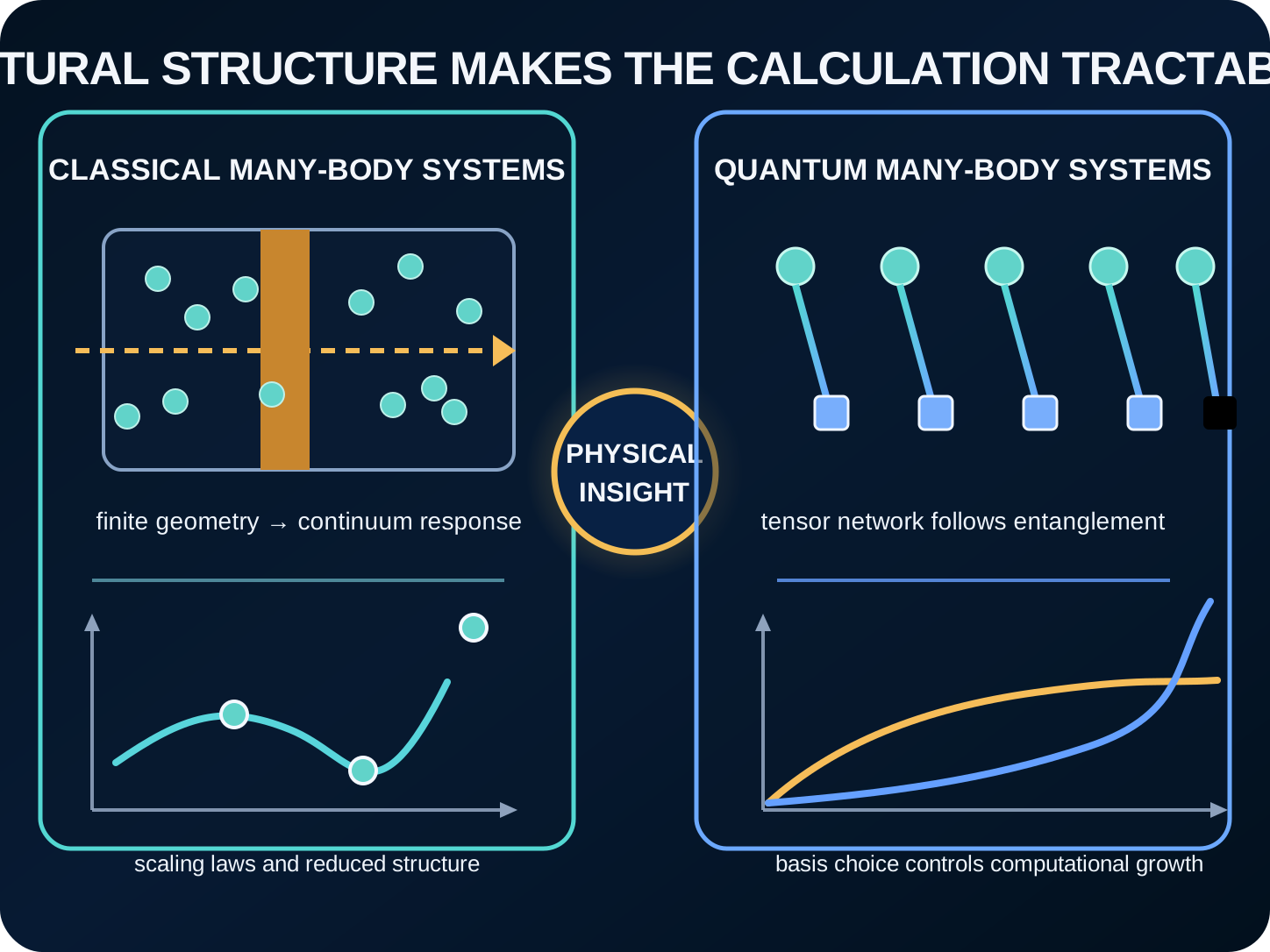
My computational-physics program asks a general question across classical and quantum many-body systems: what representation, scaling law, or numerical construction turns an apparently intractable calculation into a controlled one? The answer is often to expose physical structure hidden by a conventional coordinate system, basis, or finite simulation geometry.
- Natural representations: bases, coordinates, structural distances, and network geometries that retain the interactions and information controlling a calculation while discarding irrelevant complexity.
- Finite-size and continuum scaling: the golden-aspect-ratio construction for isolating access resistance in atomistic nanopore simulations and criteria for recovering continuum transport from finite reservoirs.
- Tensor-network transport: mixed system-reservoir representations that overcome the entanglement barrier and enable long-time simulations of interacting transport.
- Algorithmic understanding: analysis of where computational complexity is generated and why a representation remains efficient; current work identifies the Fermi-edge structure governing logarithmic entanglement growth.
Cross-scale program
Molecular physiology
Molecular physiology remains an important application domain: understanding how molecular interactions, conformational transitions, transport, and adaptation produce observable cellular behavior. It brings the three pillars together by demanding better measurements, compact molecular descriptions, and scalable computation.
The program spans single-molecule sensing, nanopores, ultrafast spectroscopy, FRET, nucleic-acid structure, cytometry, and links between molecular and cellular response.

Next
See the methods in action
Selected case studies show how these ideas become concrete measurements, representations, models, and computational methods.